A good bearded dragon setup isn't about buying the fanciest kit at the pet store. It's about nailing three things: the right heat gradient, the right UVB, and enough floor space for the animal to actually move. Get those wrong and no amount of cork bark or fake plants will save you.
I've helped rehome a dozen dragons over the years, and I've seen the same preventable problems show up again and again. Here's the practical breakdown I wish every new keeper got handed at checkout.
Quick jump-in
What size tank does a bearded dragon need?
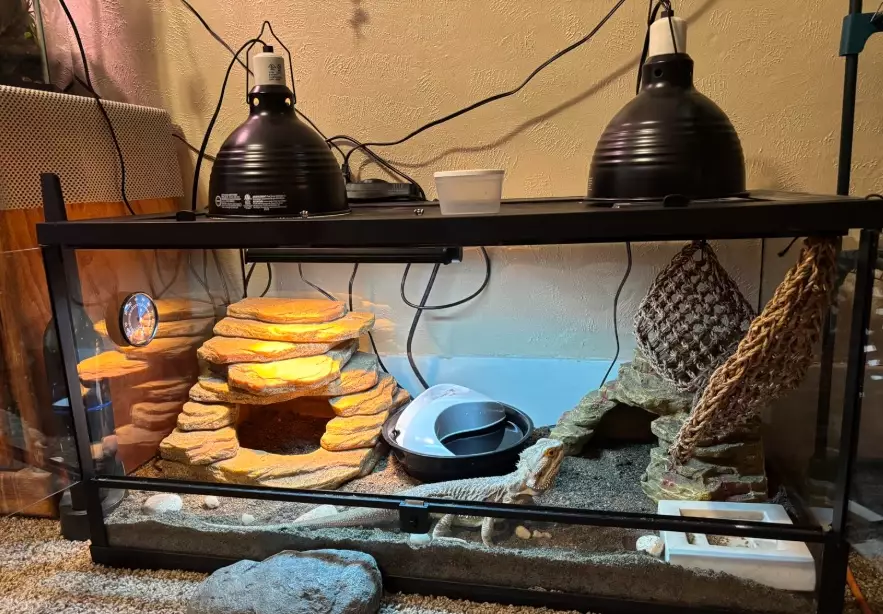
Adult bearded dragons need a 4x2x2 foot enclosure at minimum (120x60x60 cm). That's 120 gallons if you're buying glass. A 40-gallon breeder tank is fine for a juvenile under six months, but you'll be upgrading within a year — so honestly, buy the big one to start if space allows.
Front-opening enclosures cost more but save your back and the dragon's stress levels. I switched from top-opening glass to a front-slider PVC build and the dragon stopped doing that frantic scramble whenever my hand came near.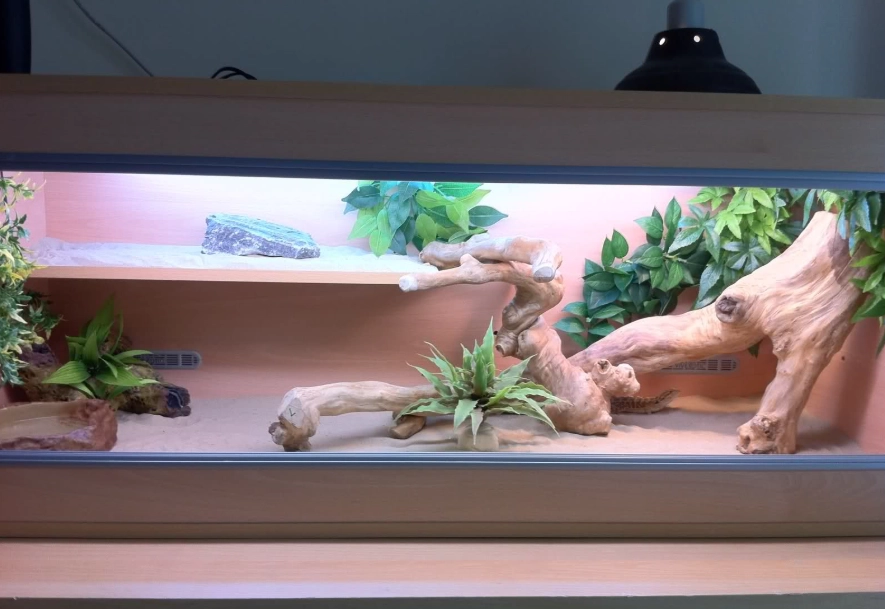
How to set up heat and UVB correctly
This is where most beginner bearded dragon tank setups fall apart. You need two separate lighting zones, not one combo bulb done sloppily.
Heat gradient
Basking spot should sit at 100–110°F (38–43°C) measured with an infrared temp gun, not a stick-on dial. The cool end stays around 80–85°F (27–29°C). A dragon that can't cool down will overheat; one that can't warm up won't digest food.
UVB
Use a linear T5 HO tube (10.0 or 12% strength), mounted inside the enclosure, spanning roughly two-thirds of the tank length. Replace it every 12 months even if it still glows — UV output fades before the visible light does. Coil bulbs are the classic mistake; they push UV into a narrow cone and contribute to eye issues.
| Element | Spec | Common wrong choice |
|---|---|---|
| Basking bulb | Flood halogen, 75–100W | Red night bulb |
| UVB | T5 HO linear, 10.0/12% | Coil compact bulb |
| Thermostat | Dimmer or pulse-proportional | On/off plug timer only |
| Temp reading | Infrared gun + digital probe | Analog stick-on gauge |
Substrate choices that won't backfire
Paper towel for the first month — it makes spot-cleaning trivial and lets you monitor poop consistency while the animal settles in. After that, washed play sand mixed with organic topsoil (roughly 70/30) gives a diggable surface that holds burrows. Loose calcium sand is a hard no; it clumps in the gut and I've seen impaction cases that required surgery.
Tile works well too, especially for keepers who hate scrubbing. Just be aware it doesn't offer digging enrichment, and some dragons get bored on flat surfaces.
Realistic setup cost breakdown
Budget around $400–700 for a proper adult setup if you buy new. Here's where the money actually goes:
- Enclosure (4x2x2) — $200–350 depending on PVC vs glass
- T5 HO fixture + bulb — $60–90
- Halogen basking bulb + dimmer — $25–40
- Thermostat — $30–60
- Infrared temp gun — $20–30
- Substrate and decor — $40–80
Vet costs are separate. Set aside $100–150 for a first wellness check and a fecal test. A dragon that comes home without a baseline exam is a gamble I wouldn't take again after a coccidia outbreak wiped out a whole clutch I bought cheap from a local breeder.
The mistakes that show up in bloodwork
Two patterns show up constantly in rescue dragons I've handled. First, UVB mounted behind mesh screens loses 30–40% of output — mount the tube inside the tank. Second, keepers trust a single thermometer. Buy a temp gun and actually spot-check the basking rock, the hot end air, and the cool hide. The gap between what a dial reads and reality can be 10 degrees or more, and that gap is the difference between basking and baking.
One less obvious point: don't cram the basking spot against the back wall. Dragons need to turn around on the hot surface. A basking platform that's too small forces them to hang off the edge all day. I learned that after watching a rescue sit half-off a branch for a week before I swapped in a wider slab.
For husbandry standards, the Association of Reptilian and Amphibian Veterinarians publishes care guidelines worth running through before you buy lights.
Questions I get asked all the time
My bearded dragon glass-surfs and glass-dances — is my setup wrong?
Usually it's one of three things: the tank is too small, the basking spot isn't hot enough, or there's no visual barrier. Try covering the sides with paper for a week and recheck temps with a gun. If the cold end is sitting at 90°F, your gradient is broken and the dragon is trying to escape the heat.
Can I use a mercury vapor bulb instead of separate heat and UVB?
You can, but they're finicky. MVBs run hot, need a specific distance, and don't work with dimmers. For a first bearded dragon setup, a T5 tube plus a halogen flood gives you more control and a wider UV footprint across the tank.
How often do I need to replace the UVB bulb if it still lights up?
Every 12 months for T5 HO tubes, or sooner if the dragon starts showing appetite drops and soft jawbones. The light output stays visually fine while UV fades — that's why so many dragons end up with early metabolic bone disease on "working" bulbs.
Is a 40-gallon tank really too small for an adult?
Yes, and you'll notice it in behavior. Adults in undersized tanks tend to pace, dig at corners, and lose muscle tone in the hind legs. Four feet of length isn't luxury — it's the floor plan a territorial, active lizard needs.
What's the one thing I should spend extra on in a bearded dragon setup?
A good thermostat and a temp gun together. Everything else can be bought used or budget-friendly; temperature control errors cause more vet visits than any other part of the setup.
This setup guide was fact-checked against current reptile husbandry guidance and hands-on keeper experience.